Full Vande Mataram Mandatory? Supreme Court Debate Explained
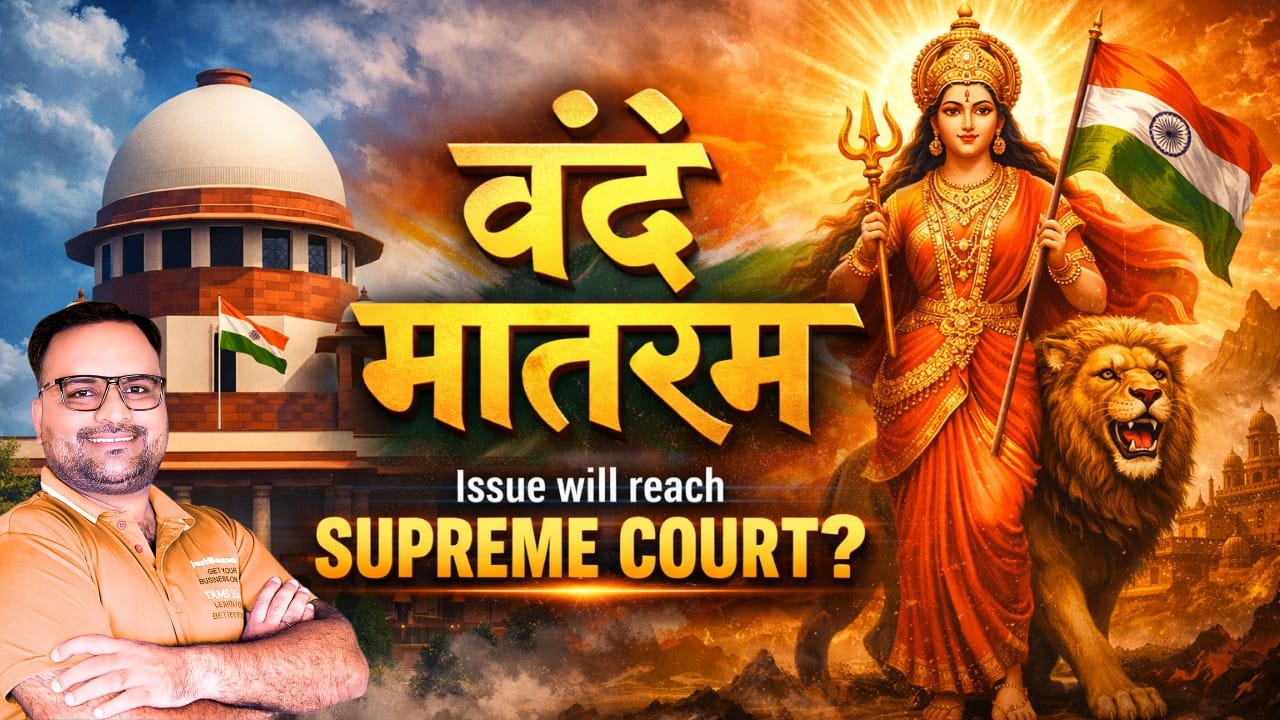
Vande Mataram is not just a song. It is an emotion, a civilizational memory, and a powerful symbol of Bharat’s national awakening. 🇮🇳
In recent days, the debate around reciting the full version of Vande Mataram (all 6 stanzas) has once again gained national attention. After a Government notification and protocol updates, many are asking:
Will the full 6 stanzas become mandatory?
Will schools be forced to recite it?
Is it constitutional?
Will this matter reach the Supreme Court?
This blog post gives you the complete historical, legal, and national perspective — without propaganda, without hate, and with full clarity.
Why Vande Mataram Is So Important in India
Vande Mataram is officially recognized as India’s National Song.
But more than an official tag, it represents:
The spirit of the Indian freedom struggle
The cultural and spiritual identity of Bharat
A collective tribute to the motherland
The civilizational pride of the Indian people
Unlike a political slogan, Vande Mataram belongs to India’s history, literature, and national consciousness.
The Origin of Vande Mataram: A Historical Overview
Vande Mataram was composed by Bankim Chandra Chattopadhyay, one of the greatest literary minds of India.
Key historical milestones:
1875: Bankim Chandra wrote the song
1882: It was included in his famous novel Anandamath
1900s: It became a rallying cry during the freedom movement
1950: It was recognized as India’s National Song
Even today, it carries the same intensity that it carried during the freedom struggle.
The Real Controversy: What Happened in 1937?
The Vande Mataram debate is not new.
In 1937, the song faced strong opposition from certain groups. The argument was that the later stanzas include imagery that is seen as devotional and references to the worship of the Motherland in divine form.
What happened next?
A political compromise was made:
The first two stanzas were promoted more widely
The remaining stanzas were often avoided in official settings
The debate was “paused” but never resolved
However, the truth is simple:
Vande Mataram is a national song written in poetic and cultural language.
It was never created to attack any religion. It was created to awaken a nation.
The Government Notification: What Has Changed Now?
Recently, Government instructions and protocol updates have brought Vande Mataram back into focus.
The major points being discussed include:
✅ 1) Full 6 Stanzas Mentioned Officially
The full text of Vande Mataram is being presented officially, indicating that the full version is being recognized.
✅ 2) Time Duration Mentioned
The time given for the full recitation is around 3 minutes 10 seconds.
✅ 3) National Protocol Events
The notification also describes where Vande Mataram may be played or recited, including:
Civil award ceremonies
Official ceremonial occasions
President and Governor formal events
National flag ceremonial moments
Public functions under special orders
The Biggest Legal Detail People Are Missing: “May” vs “Shall”
One of the most important points in the entire notification debate is the language used.
In legal terms:
“Shall” = Mandatory
“May” = Optional / Recommended
Many official functions are described with “shall”.
But when it comes to schools, the wording often uses “may”, which suggests:
👉 It is encouraged, but not always strictly compulsory.
This is a crucial detail that changes the entire interpretation of the controversy.
Why Some Groups Are Opposing the Full 6 Stanzas
Some organizations have openly stated that:
Full Vande Mataram is against secular values
It violates religious freedom
It contains references to Hindu deities
Their argument is:
Some stanzas contain devotional imagery which conflicts with Islamic beliefs.
However, a logical question arises:
If the first two stanzas were already acceptable…
Why was Vande Mataram still not recited in many places?
This is why many people believe the opposition is not against “6 stanzas”, but against the very idea of Vande Mataram itself.
Can Anyone Be Forced to Sing Vande Mataram?
This is where constitutional and Supreme Court logic becomes extremely important.
India’s Constitution protects:
Freedom of religion
Freedom of expression
Individual liberty
At the same time, it also promotes:
National unity
Respect for national symbols
Civic duty and patriotism
So the question becomes:
Can the Government force singing?
Or can it only demand respectful standing?
Supreme Court’s Past View: Standing Is Often Considered Enough
In the past, Supreme Court rulings related to the National Anthem have indicated that:
Citizens should respect national symbols
But forced singing may violate personal liberty
Standing respectfully is generally considered compliance
Now if the Vande Mataram matter reaches Supreme Court, the court may apply similar logic:
✅ Respect can be mandatory
❌ Singing cannot always be forced
Will This Matter Reach the Supreme Court?
Yes — there is a very strong possibility.
Because:
Some organizations have already said they will challenge it
The issue involves constitutional interpretation
It includes religious freedom vs national protocol
It is a national identity debate
If a petition is filed, Supreme Court may ask:
What exactly is mandatory?
Is the order forcing singing or only respectful participation?
Is it applicable in schools or only in government ceremonies?
Are there exceptions allowed?
The National Perspective: Why Bharat Must Embrace Its Symbols
Every nation in the world has symbols.
America has its anthem and flag rituals.
France has its national pride rituals.
Japan has strict cultural protocol.
Then why should Bharat hesitate?
Vande Mataram is not a religious conversion tool.
It is a national tribute.
And Bharat’s identity cannot be separated from its civilizational roots.
India is a land of:
Vedas
Yoga
Ramayana
Mahabharata
Bhagavad Gita
Dharma
Civilization older than most of the world
So when Bharat sings Vande Mataram, it is not “religion” — it is national memory.
Conclusion: This Is Not a Hate Debate, This Is a National Debate
The Vande Mataram debate must be handled with maturity.
It is not about attacking anyone.
It is about:
Restoring national pride
Protecting cultural identity
Clarifying constitutional boundaries
Creating unity through symbols
If the Supreme Court gets involved, it will likely bring clarity.
But one thing is sure:
Vande Mataram is not going away.
It is returning stronger — as Bharat awakens.
Final Words
Vande Mataram! 🇮🇳🔥
Jai Bharat! Jai Sanatan!

Social and Political Commentar, Nationalist, Mission to Make Positive Impact
Email suniltams@gmail.com

Guruji Sunil Chaudhary
Newsletter
Subscribe now to get daily updates.
Created with © FREE Super System